
Mirdif has one of the oldest villa stocks in Dubai, and that shows up in the screens before it shows up anywhere else. Mesh that has faced the Gulf sun for ten or fifteen years goes brittle. Corners tear. Splines shrink and let the mesh pull loose. Rollers on sliding screens wear flat. None of this means the house needs all-new screens, but it does mean most Mirdif villas reach a point where the screens need professional attention.
The key question: repair or replace? With so many original frames in Mirdif, the answer is often repair, specifically re-meshing. This guide explains how the decision is made and what the work involves, alongside the other fly screens in Mirdif guides. The service is described on the fly screen repair in Dubai page.

The failures you see on older Mirdif screens
Sun-damaged mesh is the most common. Fibreglass mesh hardens and discolours with years of UV exposure until it cracks at the slightest touch, usually starting at the corners and along the bottom edge where dust collects. The frame underneath is often perfectly good, which is exactly the situation re-meshing was made for.
Torn and punctured mesh comes next, and in Mirdif it usually has a family story behind it: a child’s toy, a dog’s claws, a ladder leaned against the window during villa maintenance. Small holes can sometimes be patched, but a patch on sun-aged mesh is a short-term fix on a surface that is failing everywhere. Re-meshing the whole panel is the repair that lasts.
Then there are the mechanical failures: sliding screens whose rollers have worn flat and drag instead of glide, pleated screens whose guides are clogged with compacted sand, retractable screens whose springs have lost tension. These are component repairs. The mesh and frame stay; the worn part is replaced.
Re-meshing: what it involves and when it works
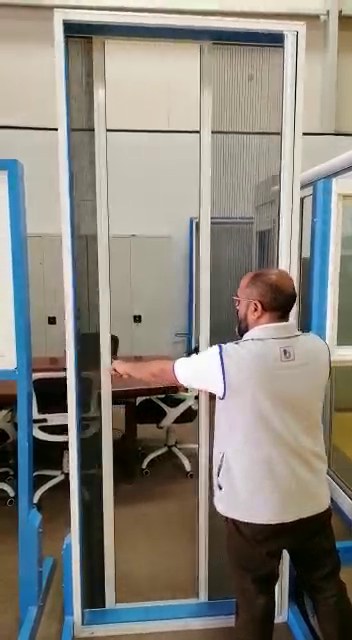
Re-meshing is straightforward. The screen is taken out of its opening, the old mesh and the old spline are stripped out, the frame is cleaned and checked, and new mesh is fitted with a new spline, tensioned evenly across the frame. The frame keeps its original colour and fit; only the working surface is new.
It works when the frame is sound: straight, with solid corners and intact fixings. Most powder-coated aluminium frames in Mirdif meet that test even after fifteen years, because the coating protects the metal and the frame itself carries no load. Re-meshing is also the right call when you want the villa’s screens to stay consistent. Doing every tired panel in the house in one round of re-meshing leaves the whole villa matching.
Re-meshing has one more advantage in older villas: it keeps the frame that already fits the settled opening, while a new frame must be measured and made to the opening as it is today. The measurement visit tells you which is simpler per opening.
When full replacement is the honest answer
Some frames are past saving. Aluminium that has corroded at the corners, frames bent by impact, and screens that were poorly made to begin with, too thin, wrong size, bodged fixings, are better replaced than repaired. So are screens on openings where the window or door itself has been replaced and the old screen no longer matches.
Replacement is also worth considering as a planned upgrade rather than a distress purchase. If half the villa’s screens are failing and the rest are the same age, doing the whole house in new matching screens, in a current frame colour and your choice of mesh, is often less disruptive than repairing in dribs and drabs over two years.
The line between the two is a judgement call made opening by opening, which is why the assessment happens in person. A technician looks at each screen, tests the frame, and tells you which ones are worth re-meshing and which ones should be replaced. No villa needs the same answer for every window.
What a repair visit covers
A repair visit starts with the survey: every screen in the villa checked and graded. Then the work itself. Re-meshing is usually done with the screens taken back to the workshop, because clean, even tensioning needs a proper bench, and the refitted screens come back and go straight into their openings. Component repairs on sliding and pleated screens, rollers, guides, springs, are more often done on site.
If you are weighing repair against replacement for the whole villa, the guide to screen types for Mirdif villas helps you see what new screens would look like, and the cost factors guide explains what drives the decision without any sales pressure.
Frequently asked questions
How long does a re-meshed screen last?
New mesh in a sound frame lasts as long as a new screen’s mesh would, because it is the same mesh fitted the same way. The frame, being powder-coated aluminium, typically outlasts several rounds of mesh.
Can a single torn screen be repaired, or does the whole house need doing?
A single screen can absolutely be done on its own. But if the torn screen is fifteen years old, its neighbours are the same age, so it is worth having them all checked in the same visit.
My frames are bent. Can they be straightened?
Minor bends sometimes, but bent aluminium rarely comes back true, and a frame that is not true will never hold mesh evenly. Replacement is usually the better answer for bent frames.
Will the repaired screens match the rest of the house?
Re-meshed screens keep their original frames, so they match by definition, and new mesh comes in standard colours to match unrepaired panels.
Do you repair screens in apartments too?
Yes. The repair service covers villas and apartments across Dubai, including Mirdif’s apartment buildings.
Next: Mosquito Nets for Mirdif Homes

