
The weeks between handover and move-in are the golden window for fly screens. Rooms stand empty, every window is reachable, and the villa can be measured and fitted without shifting a single sofa. Most new Tilal Al Ghaf homeowners discover this too late, screens become a retrofit around furniture and curtains, so this checklist exists to get the order right. Our team fits fly screens in Tilal Al Ghaf for new homeowners every month, and the smoothest jobs all follow the same sequence.
Work through it room by room before moving day, and the villa will be screened, sealed, and ready for its first evening with the doors open.
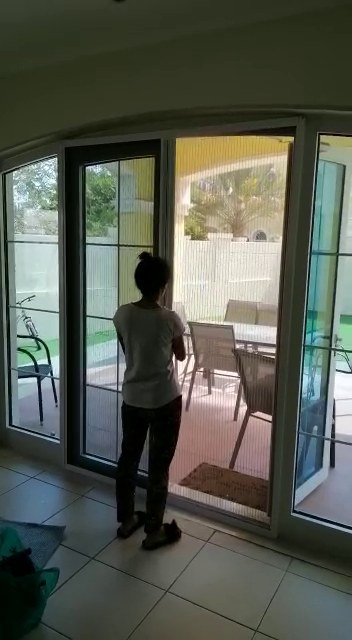
Walk the villa and list every openable window and door
Start with a notepad and walk every room, including the ones you will forget: the maid’s room, the laundry, the store under the stairs, the guest WC with its small vent window. Open each window and note its type, casement, sliding, or tilt-and-turn, and roughly how wide it is. Count the patio sliders separately, noting which panels move and which are fixed.
New-build villas in Tilal Al Ghaf mix window styles more than buyers expect. The show villa had one consistent look; your actual villa may pair tall fixed picture windows with openable casements beside them, or sliders in the living room and tilt-and-turn upstairs. The list matters because each style takes a different screen, and the survey goes twice as fast when you can hand over a complete count.
Prioritize the openings that shape daily life
Mark the five or so openings that will be open constantly: the main patio slider, the master bedroom window, the kitchen window, the family room slider, and the front door if you like a through-breeze. These are the screens to fit before move-in day. Everything else, guest bedrooms, bathrooms, the study, can follow in a second round once you have lived in the house and learned which windows you actually open.
This priority list also protects the budget. Fitting the whole villa at once is ideal, but if the move-in costs are stacking up, the high-traffic screens deliver most of the benefit. Have the full villa measured in one visit anyway, so the second batch is already specified when you are ready.
Check the window and door styles up close
At handover, look at each opening with screening in mind. Check that every window opens and closes fully and the handles turn cleanly; a stiff new window is a snagging item for the developer, and it is far easier to get fixed before screens are fitted around it. Note the frame depths, since some new-build frames sit shallow and need a particular screen profile.
Look at the patio door tracks for building dust and grit, and run each panel along its full travel. Sliding doors in new villas sometimes need their rollers adjusted after the first months of settling. Flag anything that grinds or sticks now, because a screen fitted beside a faulty door inherits the problem.
Plan around curtains, blinds, and the AC
Screens, curtains, and blinds all share the window reveal, and the order of fitting matters. Screens fix to the window frame itself, so they rarely clash with curtains, but deep curtain pelmets or plantation shutters mounted inside the reveal can crowd a screen frame. If shutters or blinds are going in, tell the screen surveyor so the frame depth is planned around them.
Air conditioning is the other coordination point. New villas run the AC hard in the first summer, and some owners delay screens until they stop opening windows. That misses the point: the pleasant months from October onward are when the villa breathes, and screens fitted in September are ready for the first cool evening. Fit for the season you will use, not the season you are in.

Do not forget the service areas
The maid’s room, kitchen, and laundry windows are the most skipped and the most regretted. These rooms sit at the back of the villa near the garden, their windows open for steam and cooking smells, and unscreened they become the insect highway into the house. A fly that enters through the laundry window ends up in the living room within the hour.
Book the survey before the furniture arrives
The practical sequence is: handover snagging first, then the screen survey while rooms are empty, then manufacture, then fitting before the movers come. That order means no furniture to shift, no curtains to work around, and no living out of boxes while technicians move through the house. Most surveys take under an hour for a villa when the opening list is ready.
FAQs
Should I fit fly screens before moving into a new villa?
If the timing works, yes. Empty rooms mean faster measuring and fitting with nothing to move or protect, and the villa is insect-proof from the first night.
Do new villas in Tilal Al Ghaf come with screens included?
Generally no. Windows and doors are handed over finished but unscreened, so screening is one of the standard post-handover jobs alongside curtains and landscaping.
What should I check on the windows at handover?
That every window opens, closes, and locks smoothly, handles turn cleanly, and sliding panels run their full travel without grinding. Report stiffness or misalignment as snagging items before screens are fitted.
Can I screen in two phases?
Yes. Screen the high-traffic openings first and the rest later. Have the whole villa measured in one visit so the second batch matches the first.
Will screens clash with my curtains or shutters?
Rarely, since screens fix to the window frame. Mention planned blinds or shutters at the survey so frame depths are coordinated.
Just collected your keys? Book the survey while the rooms are still empty and move into a villa that is ready for open doors. Get a free quote and get the checklist done before moving day.

