Jumeirah Village Circle is one of the busiest residential pockets in Dubai. Mid-rise blocks packed with studios and one and two-bedroom apartments, small balconies behind sliding doors, and the same standard aluminium windows repeated from building to building. It is practical, affordable apartment living, and it comes with two year-round companions: mosquitoes drifting up from the landscaped courtyards and pools, and fine dust blowing in from the construction sites still reshaping the area.
Fly screens solve both problems at once. They let you open the balcony door and the windows for fresh air without inviting insects in, and they cut down the dust that settles on every surface. This guide covers everything a JVC resident needs to know, from the screen types that fit apartment openings to what renters should ask their landlord. For the short version, see our page on fly screens in JVC.

Why JVC apartments need fly screens
JVC was built around landscaped courtyards, and the irrigation that keeps them green also keeps mosquito breeding spots going all year. Pools on podium levels add to it. You might assume a high-floor apartment is safe, but mosquitoes travel up in lifts and drift on evening breezes, and one open balcony door is all it takes to fill a studio with them.
Then there is the dust. JVC is still growing, with active construction sites scattered between finished blocks. Fine sand and cement dust hangs in the air, especially on windy days, and settles on floors and furniture within hours of cleaning. Screens will not block every particle, but they take the edge off, catching the larger grit before it drifts inside.
The third reason is comfort. JVC apartments are compact, and a closed-up flat gets stuffy fast. With screens on the balcony door and bedroom windows, you can leave everything open through the cooler evening hours and sleep with fresh air moving through the rooms.
The openings in a typical JVC apartment
Walk through a standard JVC one-bedroom and you will find the same set of openings in almost every tower. The big one is the balcony sliding door, usually the full height of the room and the main route for both air and insects. This is the opening that matters most, and the one most residents screen first.
Bedrooms have standard aluminium windows, either sliding sashes or side-hung casements depending on the developer. The kitchen usually has a smaller window above the sink, and bathrooms have narrow ventilation windows. The front door opens onto an internal corridor, so it needs no screen at all.
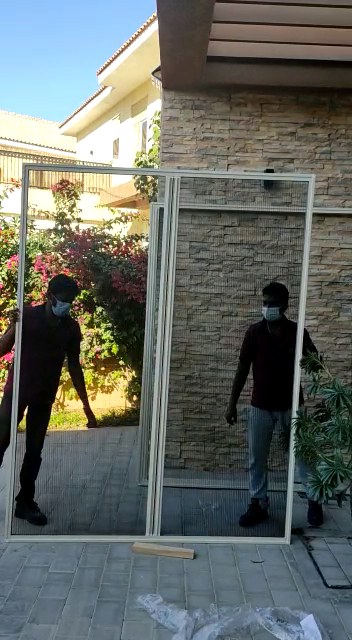
The pattern is consistent enough that screen makers know JVC openings well, but every unit still gets measured individually. Developers vary, renovations happen, and a screen that is even slightly off will not seal properly. Custom measurement is the difference between a screen that works and one that lets mosquitoes slip around the edges.
Screen types that suit JVC apartments
Three screen types cover nearly every JVC apartment. Sliding door fly screens are the natural partner for balcony doors. They run on their own slim track mounted beside the door, glide open and shut with one hand, and are made to match the full height of the door.
Fixed screens are the workhorse for windows. A simple aluminium frame holding mesh, fitted inside the window reveal, staying in place year-round with little maintenance. They suit the standard aluminium windows found across JVC towers, and you can read more on our fixed fly screens for windows page.
Pleated screens fold away like a concertina when you do not need them, leaving the opening completely clear. They suit apartments where a sliding panel would crowd a narrow balcony or where you want an unobstructed view most of the day. The right mix depends on your layout, which is why the measurement visit covers every opening before anything is made.
Renters, ordering, and installation
A large share of JVC residents are renters, and most fly screens are renter-friendly. Fixed window screens sit inside the existing frame, and sliding door screens run on tracks fitted to the door frame, so neither needs holes drilled through your walls. Anything that does need screws should be cleared with your landlord first, though most landlords welcome screens because they stay with the unit and suit the next tenant too.
Ordering starts with a free quote and measurement. A technician visits your apartment, measures each window and door you want screened, and every screen is then made to order in the workshop, cut to the exact dimensions of your openings. Installation is a tidy job, usually finished in a single visit, with each screen checked for fit and smooth operation before the technician leaves.
How long does it take to get fly screens installed in a JVC apartment?
After the measurement visit, your screens are made to order in the workshop and fitted in a single installation visit. Most JVC apartments are completed within a few days of the first call, because the openings are standard and the screens arrive ready to fit.
Can I install fly screens if I rent my apartment in JVC?
Yes. Most apartment screens fit without drilling into walls, and fixed or sliding screens can usually be removed without a trace. It is still worth a quick check with your landlord first.
Which opening should I screen first?
The balcony sliding door. It is the largest opening in a JVC apartment and the main entry point for mosquitoes and dust. Bedrooms come second, then the kitchen window.
Will screens block the breeze from my balcony?
No. The mesh is made to let air pass through while stopping insects. The airflow difference is small, and the trade is worth it on mosquito-heavy evenings.
Next: Best Fly Screen Type for JVC Apartments — matching the right screen to each opening in your flat.

