
Villa Fly Screens in Sharjah
A villa has more openings than an apartment, bigger openings, and harder-working openings. The patio doors in a Muwaileh or Al Zahia villa get used dozens of times a day. Garden dust blows straight at them. Pets treat the mesh as a suggestion. Screening a villa properly means thinking about the whole house at once, not one window at a time.
This guide covers what villa owners in Sharjah need to know: wide openings, garden-facing doors, pets, and how a whole-villa job is planned. We make fly screens in Sharjah to order in our Dubai workshop, and we screen entire villas in a single planned visit.
Start With a Whole-Villa Survey
The mistake villa owners make is screening one door, then another six months later, then the windows the year after. Each visit costs time and each partial job leaves gaps the mosquitoes keep using. A whole-villa survey at the start lists every opening, prioritises them, and lets you phase the work sensibly if you do not want it all done at once.
Our measurement visit covers the full villa: patio and garden doors, the kitchen door, bedroom and living room windows, bathroom windows, the maid’s room, and the upper floor. The quote is free at the measurement visit, and it breaks down per opening so you can decide the order.
Wide Patio Openings
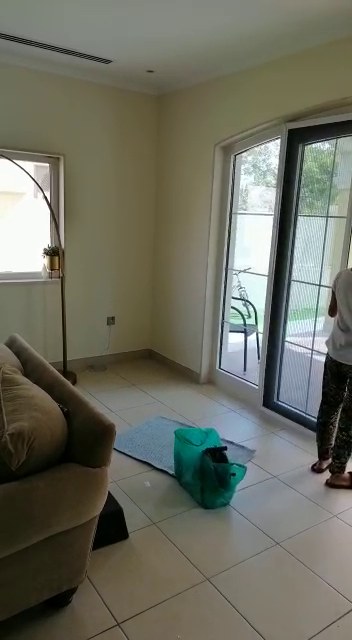
Newer Sharjah villas have wide patio doors, three to four metres of glass opening onto the garden. A single sliding screen panel cannot span that width without sagging. The options are two sliding panels that meet in the middle, or a pleated screen that folds away to one side.
Two-panel sliding screens are the straightforward choice. Each panel is a manageable width, the rollers last longer, and if one panel is damaged the other still works. Pleated screens suit owners who want the doorway completely clear when the screen is open, for parties or for moving furniture through. They cost more because the folding mechanism is more complex.
Measure the full travel of wide doors carefully. On some villa doors the screen track runs the whole width; on others it only covers part. We check this on site because getting it wrong means a screen that cannot cover the opening.
Garden Doors and Daily Use
The kitchen-to-garden door is the hardest-working door in a villa. It opens for the maid, for the children, for taking things in and out, all day long. A hinged screen on this door takes a beating, which is why the catch and hinges matter as much as the mesh. A magnetic catch that holds firmly but releases with a push survives daily use. A weak catch lets the door bang, and banging bends frames.
Garden-facing screens also collect the most debris: pollen, small leaves, grit from landscaping, and the fine dust that settles on everything in Sharjah. A monthly brush-down of garden-facing screens keeps them clear. It takes minutes and it doubles the interval between proper washes.
Pets and Screens
Dogs and cats destroy standard mesh. They push through it, claw it, and lean on it until it tears out of the spline. If you have pets, say so at the measurement visit. Pet-resistant mesh is a thicker fiberglass that survives claws and body weight far better than standard mesh.
For doors the pets use constantly, some owners accept that the mesh is a consumable and plan a re-mesh every year or two. That is a legitimate strategy and it is cheaper than replacing whole screens. We re-mesh pet-damaged panels as a standard service.
Cats have a specific habit worth knowing: they climb screens. A climbing cat puts its full weight on the mesh and the spline. Pet-resistant mesh handles this better, but check the spline seating once in a while. If the mesh is pulling out of the frame groove, it needs re-seating before the cat finishes the job.
Upper Floors and the Majlis
Upper-floor bedroom windows in villas are often left unscreened because the owners assume height keeps mosquitoes away. It does not. Mosquitoes ride the evening breeze up, and upper floors near landscaped communities get bitten as much as ground floors. Screen the upper bedrooms too.
The majlis, if it is a separate building or a ground-floor room with its own entrance, needs its own screens. Guests sit there in the evening, which is peak mosquito time, and a majlis with open unscreened windows undoes the comfort of the rest of the house.
Dust, Gardens, and Maintenance Rhythm
A villa in Sharjah lives with dust. Garden soil, landscaping work, nearby construction, and the wind off the desert all load the air. Villa screens need a cleaning rhythm: monthly brush-down of garden-facing screens, track vacuuming every couple of months, and a full wash of all screens once or twice a year.
Put it on the same schedule as the villa’s other maintenance. Screens cleaned with the AC servicing or the garden contract do not get forgotten.
Apartment owners face a different set of issues, covered in our guide to apartment fly screens in Sharjah.
FAQ
How many screens does a typical Sharjah villa need?
A standard four-bedroom villa usually has between ten and twenty openings worth screening, depending on the layout. The measurement visit lists every one, so you see the full picture before deciding.
Can you screen a villa in one visit?
The measurement is one visit. Fitting a full villa is usually scheduled as a single fitting day once the screens are made. Very large villas may split across two days.
Do screens work on villa windows with burglar bars?
Usually yes. The screen fits inside the bars on the room side. We check the clearance at the measurement visit. In rare cases the bars sit too close to the window and the screen needs a spacer frame.
Will screens stop geckos getting in?
Screens stop anything larger than the mesh weave, which includes geckos. Geckos do sometimes get in through doors left open, but they cannot pass through an intact fitted screen.
Should I screen the garage or laundry room?
If those rooms have windows you open, yes. Laundry rooms in particular stay humid and attract mosquitoes. They are small windows and cheap to screen, so there is no reason to skip them.